

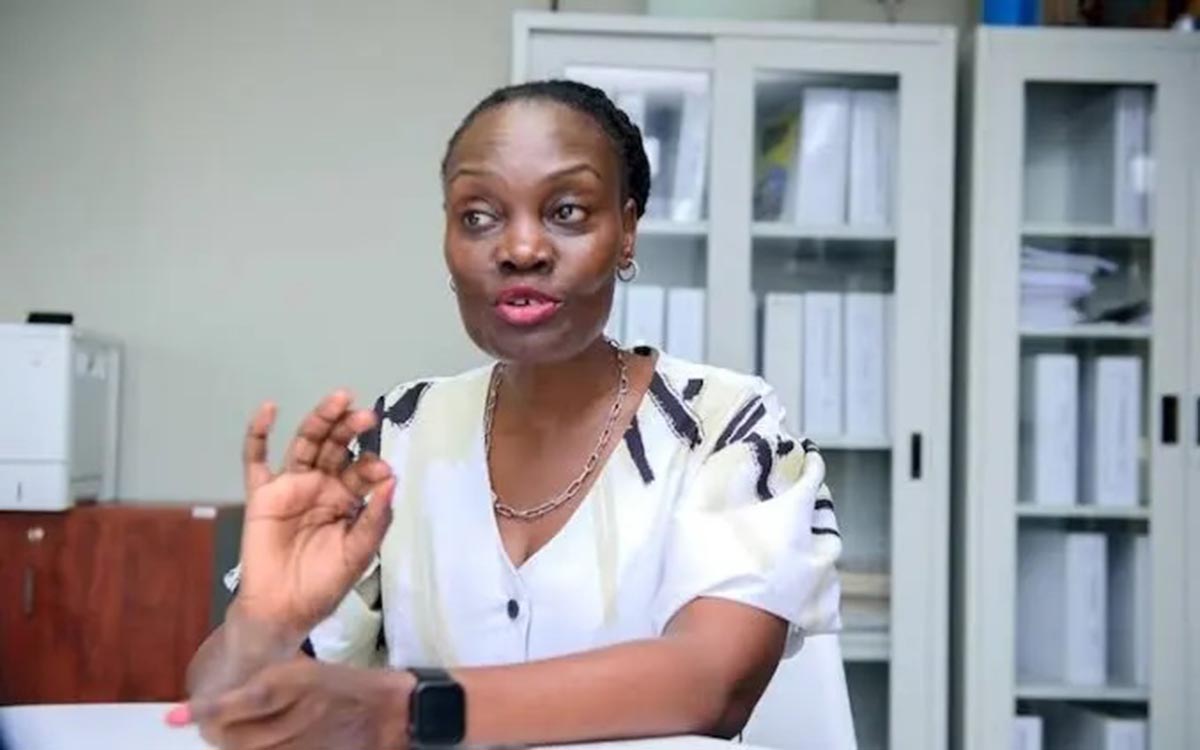

There was a media scrum after Jenifer Bamuturaki indicated that she was willing to field questions at the lobby of the House. It was August of 2022 and the chief executive of Uganda’s flag carrier, still settling into the office, had just emerged from a bruising meeting with one of the parliamentary oversight committees—the Committee on Commissions, Statutory Authorities and State Enterprises (COSASE). Bamuturaki looked weather-beaten, but—like an old school heavyweight pugilist—she bounced off the ropes determined to show that an accusation of the dearth of the energy for a fight could not be made.
If Bamuturaki had lacked the inhibition of asking for favours when she held the plum role at Uganda Airlines in an acting capacity, there was now an almost palpable steeliness about her. Joel Ssenyonyi, who as the COSASE chairperson was the heavyweight boxer on the other side, preferred to see such steeliness through the lens of self entitlement. This was much to the chagrin of Bamuturaki.
A sense of entitlement?
That sultry afternoon in August of 2022, Bamuturaki told the swarm of journalists thus: “It does not matter whether I went to the moon or whether I did MDD [music, dance, and drama]. What matters is do I have the skill? And I do. And I can’t blame myself for being appointed. That is something that will have to be requested from the board and whoever they were following.”
Barely a month in the job as the substantive chief executive of the national carrier, Bamuturaki had become the punching bag for lawmakers on the House oversight committee that yearned for both answers and retribution. They pointedly inquired about and stimulated debates over her experience, competencies, emotional intelligence or lack thereof. It is not entirely clear whether Bamuturaki had taken the possibility of the lawmakers bringing the gravest reflections to a public square seriously and prepared for the worst.
It seems hard to imagine that Bamuturaki expected the lawmakers to gloss over the fact that a nearly UGX100 million process overseen by Pricewaterhouse-Coopers (PwC) to recruit a substantive chief executive had been shot to pieces. The firm was sensationally not allowed to sift through the dozen of applicants adverts it had put out in the public media had attracted. COSASE members greeted with fierce displeasure the decision to cherry-pick Bamuturaki. She was, they collectively opined, barely known and what little people knew of her—particularly a scandal-laden stint at Sheraton Hotel—they didn’t much like.
Out of the furnace that was the House committee where she was terse in her responses, Bamuturaki hoped to use her verbosity in the full glare of the House press corps to defuse a painfully uncomfortable situation. It is unclear if she thought the tactic would get the lawmakers to back off. If she did, she soon found out how mistaken she was. More dirty linen kept being exposed during the inquest, which had to have struck a nerve with the much-maligned Uganda Airlines chief executive.
Schoolboy mistakes
Since its revival in 2019, Uganda’s flag carrier had counted a couple of chief executives in Ephraim Bagenda and Cornwell Muleya. Bamuturaki was the third. But what she did to get there cannot be said to have earned both the affection and admiration of the House committee that would months later author a damning report. When Muleya was chief executive many had looked on with increasing unease as he fought, relentlessly, with Bamuturaki, then the national carrier’s marketing and commercial director. They threw mud at each other. While the mud on Muleya initially stuck, he won UGX500 million last year after a court ruling declared that he was unfairly dismissed during what looked and certainly felt like a palace coup involving Bamuturaki.
The COSASE report, which House Speaker Anita Among ordered be shelved, ostensibly because it was leaked to the public media, deemed Muleya to have been devoid of either common sense or sophistication during the palace coup. Notwithstanding, the concerns he broached—all manners of ills, including, wait for it, inside trading—bothered the House committee with a far fiercer urgency than anything else.
Some of the shenanigans that were captured did more than threaten to cast a stain of corruption on the entire administration. In October of 2021, Bamuturaki drew $12,750 as per diem for trips she would reportedly go on not to take. Months later, in December of 2021, she would—without a witness—enter into a UGX156 million agreement with the Independent Journalists Association of Uganda (INDOJA-U). The money was splurged on 23 online publications and two individual journalists who in turn would report flatteringly about Uganda’s flag carrier. More money was shelled out during the so-called media campaign, pushing the final expenditure of taxpayers’ money to UGX315 million.
Such was the daunting breadth of the governance issues that had to be addressed that, on Bamuturaki’s watch, Uganda Airlines appeared in the Auditor General’s reports. Regularly. Despite, or in fact because, the tone of Bamuturaki’s responses was as patronising as it was disparaging, the audit’s revelations prompted uncomfortable questions over the goings-on at the national carrier. The goings-on were seen as an outrage that deserved to be condemned. It is easy to see why. During the 2022/2023 financial year (FY), Uganda Airlines paid $262,345.64 to a fictitious account that was erroneously thought to belong to Democratic Republic of the Congo’s civil aviation authority. It was widely seen as a schoolboy mistake. Rightly so.
To further complicate the optics, $103,491.70 collected at Uganda Airlines’ Juba country office was not banked during FY2024/2025. With such shenanigans happening on an unacceptable scale, the losses kept jumping. They soared to UGX325 billion in FY2022/2023, up from UGX265.91 billion. The Auditor General noted that this was, in no small part, due to the airline’s “significant 39.8 percent increase in direct costs of UGX140 billion.” Bamuturaki’s monthly pay cheque, believed to be north of UGX80 million, a figure she disputes, helped ensure that a messy plot unravelled fast. And while the net loss dropped to UGX230.816 billion in the 2024/2025 FY, this was a razor thin improvement of 0.33 from the previous year.
Observers contend that the losses are neither a Freudian undercurrent nor teasing mystery. The failure of the national carrier to extricate itself from the damaging embrace of governance lapses left considerable blots on its ledger. Colossal errors registered in the airline’s procurement processes and expansionist policy have had a damaging impact on the bottom line. The damage has proved extraordinarily durable.
Turning the page
While it is demonstrably true that Bamuturaki nibbled at more than she could chew, in more ways than one, many missteps predate her. Critics reckon that responsible authorities have steadfastly ignored the elephant in the room: whether Uganda Airlines’ revival in 2019 should have considered cargo operations, to a certain extent, as a viable and significant revenue stream. A business model entirely predicated on the external trappings of passenger transport—moreover with the size of Uganda’s flag carrier—makes the occurrence of backward-thrusts excruciatingly obvious. What is also obvious is that the national carrier will expect to be met with the forward-thrust of a scandal-free chief executive in July of 2026 when Bamuturaki finds the departure lounge at the airport terminal.
Could Girma Wake be about to saunter into the arrivals lounge then? The man who served as the chief executive of Ethiopia’s flag carrier from 2004 and 2011 and later board chairman of the Ethiopian Airlines Group met President Museveni at State House, Entebbe, in early February. Economical with information from the meeting, President Museveni tersely revealed that they “discussed matters regarding air transport among other issues.” That was enough to whet the appetite of Ugandan aviators like Mike Mukula who contended that Wake’s “strength lies in interim stewardship, governance, and strategic oversight, not permanent command.” In a February 5 X (formerly Twitter) post, Mukula opined that Uganda Airlines “must realign internal systems, reinforce safety driven reporting, and modernize compliance and performance accountability.”
“For Uganda Airlines, maintenance hangars are strategic assets critical for airworthiness, cost control, AOG reduction, and long-term sustainability. Investment in MRO capability must align with fleet growth and route economics,” the aviator further wrote.
Running into turbulence
Last December, Gen Katumba Wamala, the Works and Transport minister, told the House’s Budget Committee that UGX422.264 billion of a UGX1.696 trillion supplementary request his ministry made was to be ring-fenced for the procurement of 10 aircrafts for the national carrier.
“Uganda Airlines [is] in the process of acquiring 10 aircrafts comprising four mid-range or narrow-body Airbus models, four wide-body Boeing aircraft and two Boeing converted freighters for cargo. The supplementary budget is to cater for the projected initial requirements for the aircraft purchase for this financial year 2025/2026,” Gen Katumba told the House committee.
“It includes pre-delivery payments at purchaser agreement signature amounting UGX247.019 billion and sharing UGX275.245 billion for the pre-delivery payment that will be required in January 2026 from both manufacturers Boeing and Airbus,” he added.
The request stimulated debates amongst the committee members over the reasonable steps (or lack thereof) taken to ensure that the managers of Uganda’s flag carrier were not burning through money as they did whilst putting together the fleet that headlined the 2019 revival.
“You remember the Bombardiers we bought. Later on, we soon discovered that there were no spare parts. They were no longer in production and I don’t know what we are going to do with those aircrafts,” Paul Omara, the Otuke County legislator, told “Gen Wamala, adding, “We would want to have assurance from you and the team that this procurement that you will do will be a show of future support for those 10 aircrafts.”
The committee members were not entirely convinced, but, regardless, still cleared the national carrier to partake of the subvention. In July, a new chief executive will be tasked with charting a new path so that the plans for Uganda’s flag carrier do not come haltingly into the orbit of turbulence. The ‘fasten seatbelts’ sign could be about to start blinking, Intermittently.